Featured Smartwatch & Wearable Electronics Portfolio
Direct from our ISO 9001 certified OEM/ODM manufacturing facility. Engineered for global compliance, high optical yield, and extreme environmental durability.


Executive Whitepaper: Sourcing Smartwatches with Integrated Cameras
An engineering and procurement analysis for enterprise brands, telecommunication operators, and global distributors.
The global wearable device ecosystem is experiencing a seismic shift. No longer confined to basic step counting or passive heart rate tracking, modern wrist-worn form factors have transformed into fully autonomous edge-computing communication hubs. Among these innovations, smartwatches integrated with miniature optical camera sensors represent one of the fastest-growing OEM/ODM categories globally. From child safety and elderly telecare to rugged industrial field operations and remote video conferencing, adding visual capture capabilities to ultra-compact hardware creates tremendous product differentiation—and complex manufacturing challenges.
As a premier OEM/ODM manufacturer headquartered at the epicenter of smart hardware manufacturing, our engineering operations integrate high-precision micro-optics, low-power cellular processors (4G LTE/5G eSIM), custom Android/RTOS firmware development, and rigorous industrial enclosure sealing. This whitepaper breaks down the optical engineering, regulatory landscape, manufacturing yield controls, and future sourcing trends essential for enterprise buyers seeking trusted supply partners.
Global Telecom Compatibility
Full multi-band LTE/WCDMA RF optimization supporting major North American, European, and Asian carrier frequencies with global VoLTE voice/video stability.
Hardware-Level Privacy & Security
Incorporating firmware-locked camera access protocols, AES-256 encrypted media pipelines, and compliance with COPPA, GDPR, and FCC regulations.
High-Precision Optical Yield
Class 10,000 dust-free optical assembly cleanrooms ensuring zero-particle sensor contamination, high glass light-transmittance, and zero lens flare.
Technological Deep Dive: Camera Smartwatch Engineering & OEM Architecture
Integrating a Compact CMOS Image Sensor (CIS) into a chassis constrained to less than 45mm x 45mm x 14mm requires balancing five distinct engineering vector trade-offs: thermal dissipation, RF noise interference, optical lens alignment, battery power budgets, and mechanical ingress protection.
1. Optical System Selection & PCB Thermal Management
Unlike smartphones with spacious volumetric interiors, smartwatches accumulate heat rapidly during 720p or 1080p video transmission. When the image signal processor (ISP) inside chipsets such as the MediaTek MTK6739, Spreadtrum SL8541E, or Qualcomm Wear platforms runs concurrently with 4G PA modules, localized temperatures can breach 55°C within minutes.
- Custom Flexible Printed Circuits (FPC): We design ultra-thin, double-shielded EMI flex cables connecting the camera module directly to the mainboard, eliminating high-frequency video clock noise from degrading GPS/GNSS receiver sensitivity.
- Synthetic Graphite & Copper Foil Heat Spreading: Multi-layered thermal dissipation paths draw heat away from the CMOS sensor substrate toward the rear alloy casing, preventing thermal throttling during extended two-way video calls.
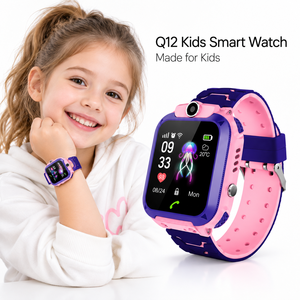
- Fixed-Focus vs. Auto-Focus Modules: For kid/safety smartwatches, custom micro fixed-focus lens assemblies (F/2.2 aperture, 84-degree FOV) are deployed to ensure extreme shock resistance against drops while eliminating bulky voice-coil motors (VCM).
2. Structural IP68 Waterproof Engineering for Camera Windows
A primary failure point in second-tier smartwatch manufacturing is seal degradation around the camera lens port. Water ingress occurs when dynamic fluid pressure overcomes planar structural gaskets.
Our OEM facility utilizes a proprietary Dual-Injection Molded Housing with Laser-Bonded Sapphire/Corning Glass lens covers. By chemically bonding the optical cover glass directly into the PC+ABS frame, we achieve seamless IP68 immersion protection (up to 1.5 meters for 30 minutes) and 5ATM resistance without requiring bulky mechanical retaining rings.
Future Procurement & Sourcing Trends (2025–2030 Horizon)
Where the smartwatch camera industry is headed and how procurement leaders can future-proof their supply chains.
Global procurement teams must evaluate hardware suppliers not merely on current FOB unit costs, but on their technological roadmap alignment for the next 3 to 5 years. Below are key macroeconomic and technical trends shaping the OEM smartwatch camera market:
A. Dual-Camera Architecture & 90° Flip-Up Mechanisms
Single front-facing lenses are increasingly giving way to dual-camera configurations. Premium models integrate a front-facing 2MP camera for video teleconferencing paired with a top-mounted 5MP or 8MP environment-facing camera for quick document scanning, QR payment processing, and ambient photos. Innovative flip-up rotating mechanisms engineered with micro-friction hinges (tested up to 50,000 rotation cycles) enable 180-degree field-of-view capture without compromising wrist stability.
B. AI Visual Processing at the Wearable Edge
As micro-NPU (Neural Processing Unit) silicon achieves sub-watt power draw, next-generation camera smartwatches are incorporating edge-AI functionality directly into OEM ROMs. Key implementations include:
- Automated Emergency & Fall Video Capture: Triggering instant short video recording sent to emergency contacts upon detecting heavy impact or sudden acceleration anomalies.
- Parental Content Filtering at Capture: On-device neural networks that automatically blur sensitive imagery prior to cloud sync, protecting minors' privacy without relying on cloud processing latencies.
- OCR Text Recognition: Instant optical scanning of text for real-time speech translation—ideal for international travelers and educational devices.
C. Low-Power Display-Under-Screen Optics
To maximize active screen-to-body ratios on AMOLED panels, top-tier ODM designs are adopting under-display camera (UDC) technology. By utilizing micro-transparent pixel matrices above the camera sensor zone, brands can offer bezel-less edge-to-edge displays while retaining discreet front camera functionality.
Why Partner With Us: Direct Factory OEM/ODM Competence
Combining world-class SMT automation with comprehensive software customizability to bring your wearable vision to market faster.
End-to-End Tooling & ID
In-house CNC mold-making, industrial design (ID), and mechanical structure (MD) engineering. We transform initial sketch concepts into mass-production tooling within 35 calendar days.
Custom Firmware & App SDKs
Complete Android (AOSP) and RTOS kernel optimization. We offer white-label Mobile Device Management (MDM), custom launcher locking, OTA update servers, and iOS/Android companion app source code integration.
Zero-Defect Quality Control
Every unit undergoes 100% automated optical inspection (AOI), 4G/5G RF chamber testing, salt-spray corrosion exposure, thermal shock cycle testing (-20°C to 60°C), and 3-bar hydrostatic pressure testing.
Smartwatch Sourcing & Procurement FAQ
In-depth answers addressing common technical, regulatory, and logistics inquiries from commercial buyers.
What is the typical Minimum Order Quantity (MOQ) for custom OEM/ODM smartwatch orders?
For standard factory-neutral housing colors with customized packaging and logo laser-engraving, our MOQ starts at 500 units. For full OEM custom tooling, specialized casing colors, or custom PCB layout modifications, the baseline MOQ is 2,000 to 3,000 units depending on components.
Can you pre-install custom Android applications or lock the device into a Single-App Kiosk Mode?
Yes. As a primary ODM hardware manufacturer, we provide custom firmware flashing at the factory production line. We can pre-integrate your proprietary Android app into the system partition (making it non-removable by end users), configure kiosk mode, customize boot animations, and hardcode custom APN settings for dedicated M2M/IoT SIM cards.
How do you handle privacy regulations such as GDPR and COPPA regarding integrated cameras?
We work directly with brand owners to ensure hardware and software compliance. Hardware-wise, we can implement LED record-indicator diodes that illuminate whenever the camera sensor is active. Software-wise, media streaming channels use end-to-end TLS 1.3 encryption, and cloud storage integrations comply with EU-GDPR and US COPPA standards.
What international quality and telecom certifications do your smartwatches possess?
Our manufacturing plant operates under ISO 9001 and ISO 14001 quality standards. Our standard product platforms are engineered to meet CE, FCC, RoHS, REACH, and RED compliance. Carrier-level certification (such as PTCRB or GCF) can be conducted alongside our third-party lab testing partners upon request during project initiation.
What is the production lead time for bulk orders?
Standard trial orders ship within 7 to 10 working days. Customized OEM mass production orders typically require 25 to 35 calendar days following golden sample approval and component procurement freezing.
How do you guarantee IP68 water resistance during high-volume assembly?
We utilize 100% inline automated negative-pressure air leak detectors on every assembled case before final packaging. Unlike spot-checking sample methods, this guarantees that 100% of dispatched units adhere to water and dust ingress ratings.